Most Minecraft mega base ideas that actually get screenshotted share one thing: a clean curve in a sea of cubes — a glass sphere on stilts, a domed hall, a ring of round towers. Curves read as effort because they’re genuinely hard. Place a big circle by eye and it closes a block short, every time.
TL;DR: The strongest circular mega base builds — a glass sphere landmark, a domed hall or biodome, round walls with corner towers, an oval arena — all start as one circle, sphere, or dome you plot exactly before placing a block.
Table of contents
Open Table of contents
- Start with the footprint, not the first block
- A glass sphere is the build everyone screenshots
- Domes turn a flat base into a skyline
- Round walls and corner towers, the medieval way
- The arena is where circles and ovals earn their keep
- A round base reads even better underground
- Fitting the circles together without a mess
Start with the footprint, not the first block
Every mega base guide opens with the same advice: plan before you place. For a circular base that means fixing the footprint of each round piece up front, because a circle is the one shape you can’t quietly fix later — once a 60-block wall is two blocks out of true, you’re tearing down an arc, not nudging a line.
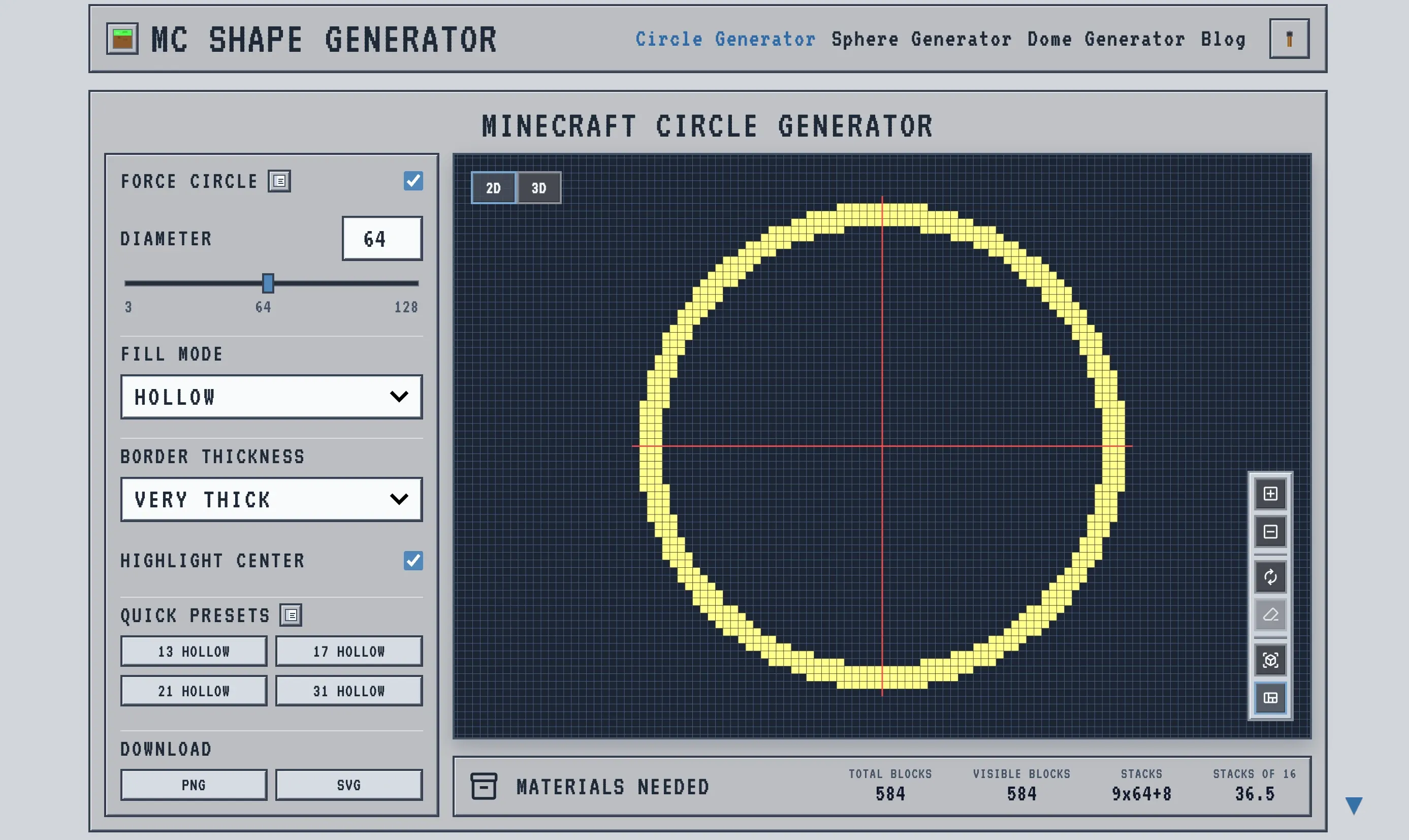
This is the part hand-building punishes. Builders keep landing on the same conclusion across forum threads: you can’t eyeball a large circle, so plot it first. The Minecraft Circle Generator does exactly that — set a diameter anywhere from 3 to 128, read the exact ring back, and switch on Highlight Center so the crosshair marks the middle before you commit. On the really big rings, the axis method for giant circles keeps all four quarters honest so the far side doesn’t close short.
Sketch the whole base this way first — wall ring here, dome there, towers on the corners — and it stops being one overwhelming project. It becomes a handful of circles you already know the size of.

A glass sphere is the build everyone screenshots
Across the circular builds that get shared, the glass sphere shows up more than any other. A globe you can see from the next biome, a planet-style orb, a containment dome over a single tree — it’s pure flex, because a freehand sphere is nearly impossible to keep round.
A sphere is stacked rings, each a different diameter, and eyeballing that taper is exactly where it collapses into a potato. The 3D Sphere Generator renders the whole ball layer by layer — drag the layer slider and the current ring lights up yellow over the ghosted layers below, so you place one clean circle at a time. Go hollow for a glass shell and the panel hands you the block count and stacks, so you know it’s a four-shulker glass run before you mine anything.
Diameter is the only real decision. The sphere build guide walks through picking one and the layer-by-layer method; 30 to 40 blocks is the sweet spot — big enough to live inside, small enough to glass over in an evening. Push past 50 and it becomes a landmark you build the rest of the base around — a moon over a spawn town, an end-themed orb in purpur and obsidian; under 20 it stays an accent, not a centerpiece.

Domes turn a flat base into a skyline
A dome is half that sphere, and it earns more per block. Cap a great hall, roof a spawn platform, or glass one over farmland for a biodome — the curved roofline is the difference between a mega base and a big box with a flat lid on it.
The Dome Generator is the same sphere math stopped at the equator, so it builds the same way: a wide base ring courses up to a single capstone, layer slider and ghost layers included. The glass biodome is the high-impact version — light gets in, mobs stay out — and the step-by-step dome tutorial takes the base ring all the way through the cap. Around 40 blocks across gives you headroom for full farms underneath; much smaller and it reads as a roof, not a room.
One honest limit: the dome is isotropic, a true circle on every layer. If you want a long barrel-vault roof rather than a round dome, that’s a stretched profile the generator won’t plot — you’d extrude the arch by hand.
Round walls and corner towers, the medieval way
The classic mega base silhouette is a walled compound, and round beats square here — sturdier in the lore, and on the grid it just looks deliberate instead of default. A large circular curtain wall with towers at the cardinal points gives you a fortress footprint a square layout never quite matches.
Plot the perimeter as one big hollow circle — 64 or 100 blocks across — with Border Thickness set to thick so the wall has real depth, then clear the inside for everything else. The towers are where the tool asks for honesty: there’s no cylinder or tower generator here. A round tower is the same circle stacked floor on floor, which is the exact workaround the castle round tower guide runs through — diameter by role, odd-versus-even for the staircase, and how the roof finishes the silhouette. Pick a tower diameter that divides into the wall cleanly and the corners look planned, because they are. A moat is just a second, larger circle dug one ring outside the wall and flooded; a gatehouse breaks the ring where two arcs meet a short straight span.
The arena is where circles and ovals earn their keep
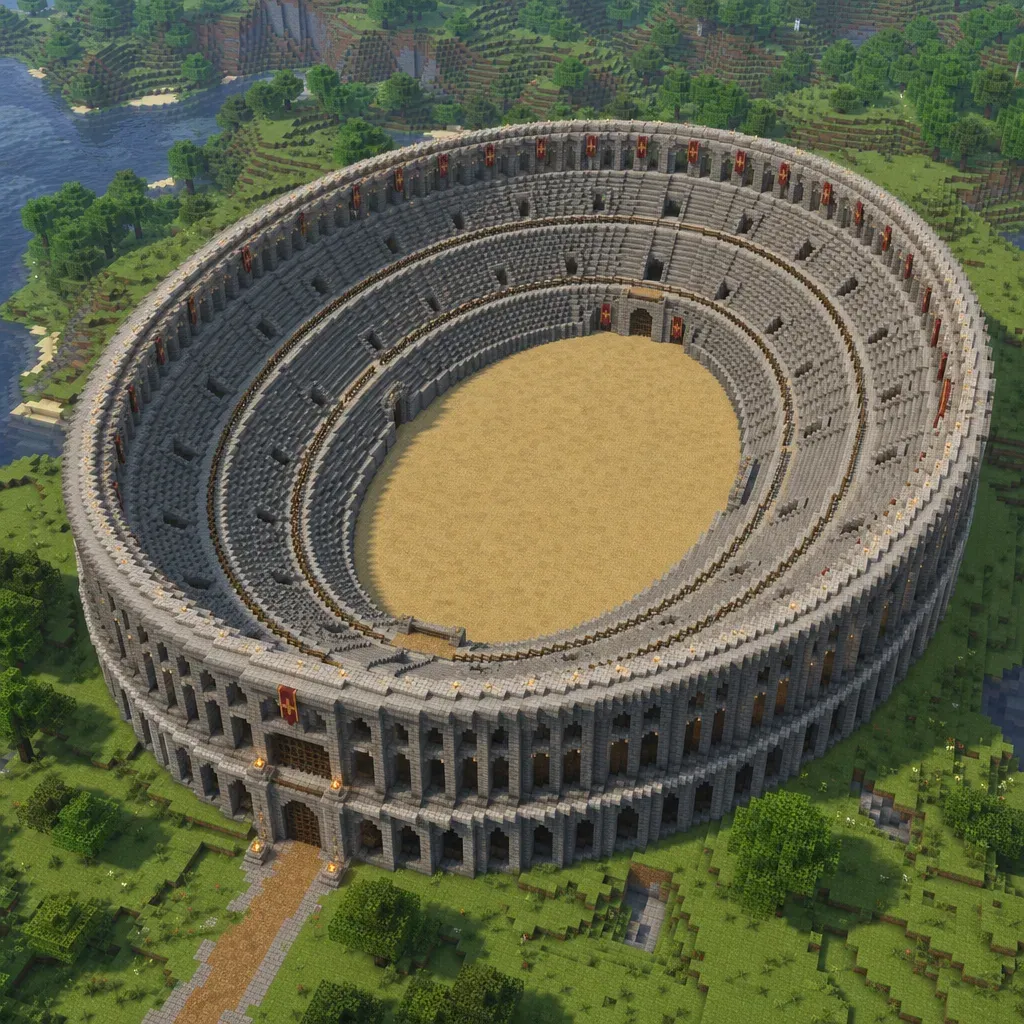
Inside the walls, the centerpiece is an arena. A coliseum is concentric rings — an outer wall, a stepped seating bowl, an open field — and a real coliseum is an oval, not a circle, because the long axis gives the floor room to breathe. Set Width and Height apart on the oval generator — say 61 by 41 — and it plots the ellipse block for block; the step-by-step guide walks the whole build.
That concentric trick scales down to the rest of the base. A ring of farm plots around a central silo, a round market plaza, a sunken garden stepped in tiers — each is just a few circles sharing one center. Turn on Highlight Center and every ring snaps to the same crosshair, so they stay true to each other instead of drifting off-axis as they grow.
A round base reads even better underground
Not every mega base sits on the surface. A circular footprint sunk into the ground, or carved into a cliff face, is one of the cleaner ways to hide a build this big — and the curve does more work down there than it does up top. A round chamber under a domed ceiling reads as a planned vault; the same space as a square pit just reads as a hole you stopped digging.
Plot the floor exactly like a wall ring — a hollow or solid circle, 40 to 80 across — then excavate down to it. The ceiling is where it gets good: a dome over a sunken atrium with a glass oculus at the crown drops daylight straight into the base, and a sphere buried halfway makes a spherical chamber you’d never manage freehand. The catch underground is that you can’t back up and check the silhouette, so the exact ring from the Circle Generator matters more here than anywhere — every block is committed before you can see the shape from outside.
A cliff base runs the same play sideways: a half-dome cut into the rock with the flat face open to the drop, the round profile carrying the whole look. That’s a punishing amount of mining for a shape, which is the best argument going for reading the block count before the first pickaxe swing.
Fitting the circles together without a mess
The trap with a circular mega base is that every piece looks fine alone and then fights its neighbors once assembled — a wall ring clipping the dome, towers spaced so the gaps land at random. The fix is dull and it works: pick diameters that share factors. A 64-block wall, 16-block towers, a 32-block dome — everything sits on the same grid, so circles meet circles cleanly instead of overlapping by three awkward blocks.
That last part is the one thing the generators won’t do for you. Each tool plots a single shape; it won’t lay out the whole base or export the compound as a schematic, so the arrangement stays your call. What it removes is the part that actually breaks builds: every individual circle, sphere, and dome comes out exact, counted, and centered.
So pick the footprint that excites you — the sphere, the dome, the walled ring — and plot that one shape first on the Minecraft Circle Generator. A mega base is really just circles that agreed to share a center; the tool’s only job is making each one come out round.