Most Minecraft fountains look broken the moment they’re built. The water spreads where you didn’t want it, the ring sits one block off-center, the whole thing reads as a square slab with a wet patch.
The three designs below cover what actually gets built — a clean round garden fountain you can finish in twenty minutes, a multi-tier cascade that sits at the center of a plaza, and themed variants for castles, gardens, temples and cottagecore builds. All three share the same water-flow rules. Most of the difficulty is in the rim, not the spout.
Table of contents
Open Table of contents
How fountain water actually flows
The whole game of fountain-building is one rule: place one source block at the top, the rest is gravity. Drop a water bucket in the highest stone basin and Minecraft spreads it seven blocks down each face. Drop a second source on the same level and it merges with the first — useful for wide basins, dangerous if you wanted a single jet.
Two practical knobs come out of this:
- Height of the spout = layers stacked above the basin floor. Each extra layer adds about one block of visible water column.
- Spread of the pool = how far the bottom rim sits from center (7 blocks max before flow stops). Anything wider needs a stepped basin so each step gets its own source block.
Internalize those two numbers and the three designs below are just variations on them.
Design 1 — The Round Garden Fountain
The single-tier round fountain is the design most builds need and most builds get wrong. The trouble isn’t the water — it’s the rim. Minecraft’s voxel grid drifts one block out of alignment if you eyeball a circle, and the bigger the diameter the worse it gets.
The fix is to grab a layer-by-layer blueprint from our Minecraft Circle Generator, set the diameter, and copy the ring face by face. Odd diameters (7, 9, 11) give you a single center block for the spout pillar — that’s what you want. Even diameters force a 2×2 spout, which works for wider basins but looks off-center on small ones.
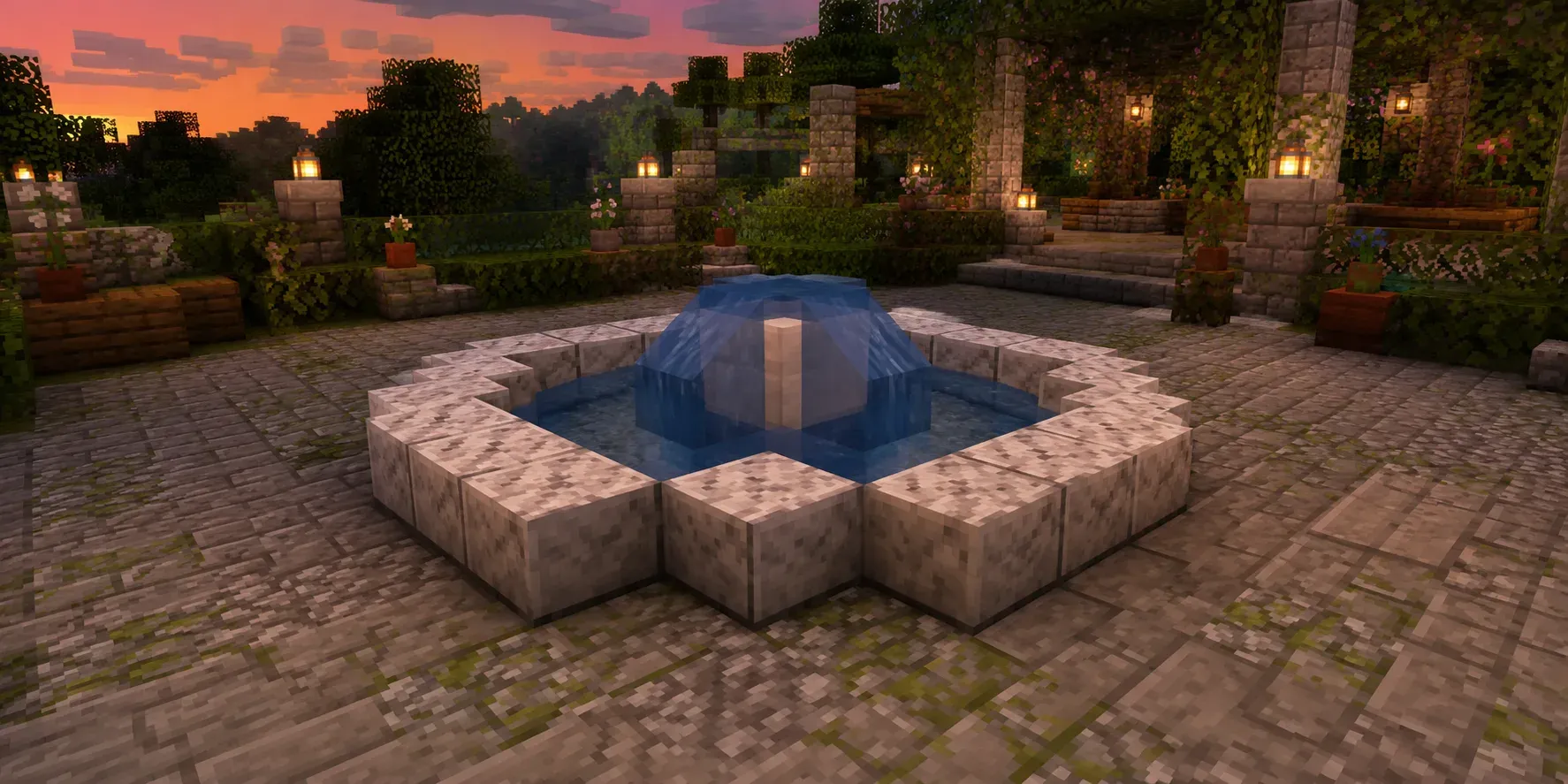
Three diameters cover most use cases:
- Diameter 7 — chapel entrance, small garden, courtyard corner. Tight, reads as accent piece. Single quartz pillar at center, one block tall, water source on top. ~24 cobble for the rim + 1 quartz + 1 water.
- Diameter 9 — the workhorse. Wide enough that the falling water pools look intentional, small enough for a backyard. Use a two-block-thick rim if you want a wider lip. ~32 cobble + 1 pillar + 1 water.
- Diameter 11 — upper edge before single-pillar fountains look sparse. At this size, swap the central pillar for a 2×2 square pillar — the wider top reads as deliberate, the splash spreads further, and you get corner space for banners or campfires that fake steam at dusk.
Material swaps:
- Polished diorite + quartz pillar — clean cathedral default for formal gardens, churches, and chapel courtyards.
- Mossy cobble paired with chiseled stone reads as ruins or old garden. Drop a few cracked-stone blocks in the rim for the aged feel.
- Stripped birch logs + grass blocks ringed with flowers is the cottagecore set. Best survival-friendly because birch is easy to harvest in any forest biome.
- Replace water with lava on a blackstone rim and you get the villain throne room. Build on a stone island; lava burns flammable blocks within two tiles.
Common round-fountain mistakes:
- Off-center pillar. On odd-diameter circles (7, 9, 11) the center is a single block. Place the spout on the wrong adjacent block and water flows asymmetrically. Use the generator’s “Highlight Center” option to see the exact center voxel before placing the pillar.
- Two source blocks at the spout merge into one combined flow and create dead pockets where no water moves. One source per spout, period. If you want a wider jet, raise the basin floor instead of doubling sources.
- Last one is the rim-to-spout height mismatch. If the rim is one block tall and the spout is three blocks above the basin floor, water cascades over the rim and floods the path. Make the rim two blocks tall, or lower the spout to match.
Design 2 — The Multi-Tier Cascade
Stacking concentric circles is where fountains stop looking like backyard accents and start looking like centerpiece pieces. It’s also where the one-block drift problem stops being annoyance and becomes the build-killer.
When you place an 11-block ring and a 7-block ring on the same center, both rings need to share the same axis cross. Eye it and you’ll be off by one — guaranteed. The fix isn’t more practice; it’s the Axis Method from how to align giant Minecraft circles, which uses cardinal markers (top, bottom, left, right) so each subsequent ring snaps to the same crosshair.
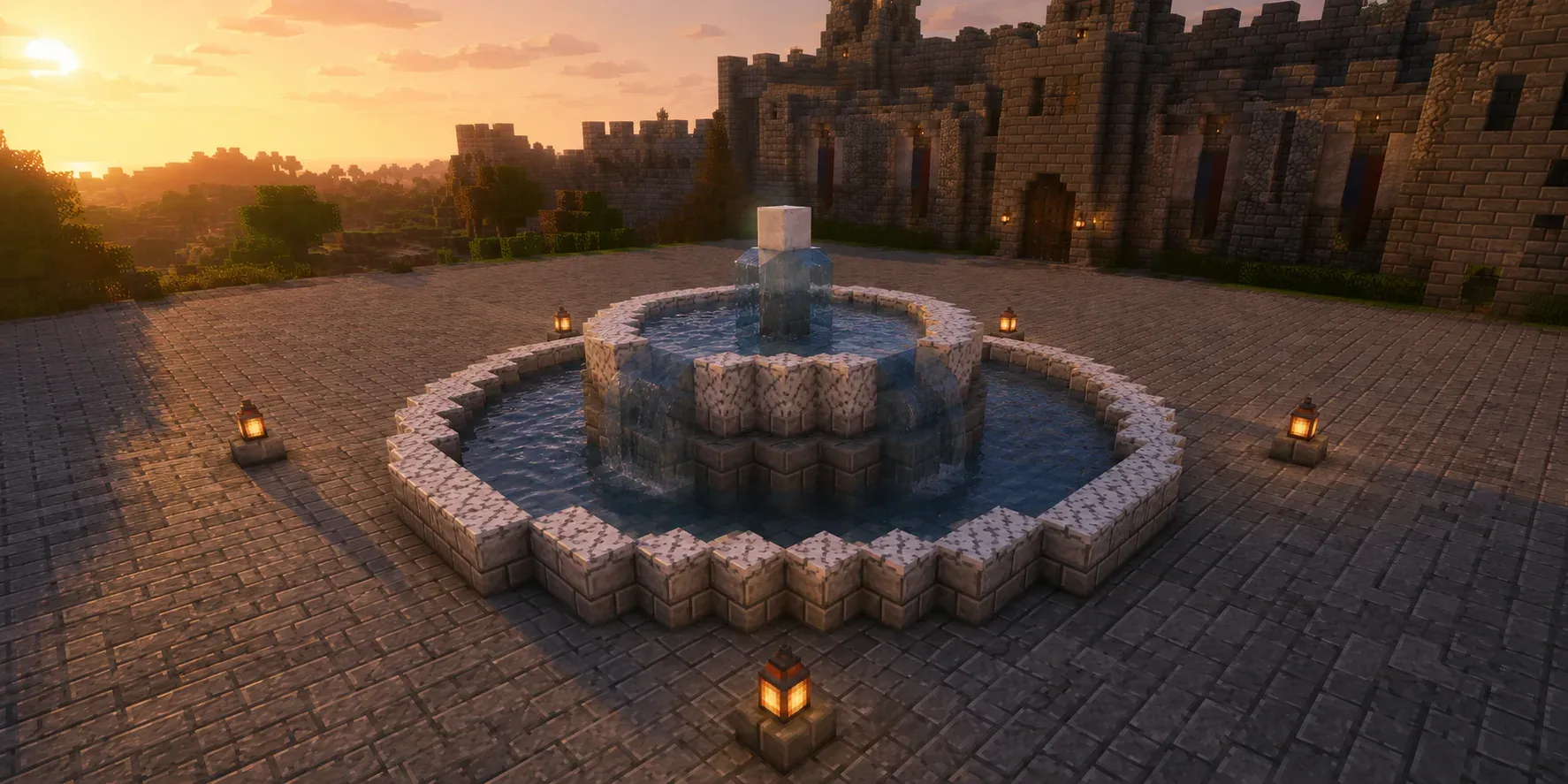
The classical two-tier cascade (11 + 7):
- Outer ring: 11-block diameter, two blocks deep. Stone or polished andesite for the cleanest look.
- Inner ring: 7-block diameter, raised two blocks above the outer rim on a stone plinth. Same center as the outer ring (axis method, not eyeballed).
- Spout: Single quartz block at the very top of the inner ring center. Water source on top, falls into inner pool, overflows into outer pool. Two pools fill in about ten seconds.
- Lighting: Lantern on each cardinal corner of the outer rim. Optional sea pickles in the outer pool for an underwater glow.
~70 blocks total, builds in 30-40 minutes once the rim is planned.
The mega plaza three-ring (15 + 11 + 7):
For mega-base spawn areas or centerpiece courtyards, scale up to three concentric rings. The math doesn’t change — same axis cross, each subsequent ring is the next odd diameter inward.
- 15-block outer ring needs ~70 cobble alone.
- Total block count: ~180 for all three rings + plinths.
- Visual payoff: the closest Minecraft gets to a Versailles fountain.
Plan the cardinal axes before placing a single block. Once you start stacking rings, alignment mistakes propagate downward — fixing a misaligned 15-block rim means tearing it out and starting over.
Design 3 — Themed Variants Showcase
The geometry is only half the job. The other half is what the fountain reads as — castle, garden, temple, ruin. Four themed variants below cover the most common build contexts. All four use the round-base technique from Design 1; the difference is materials, surroundings, and what’s on top of the spout.
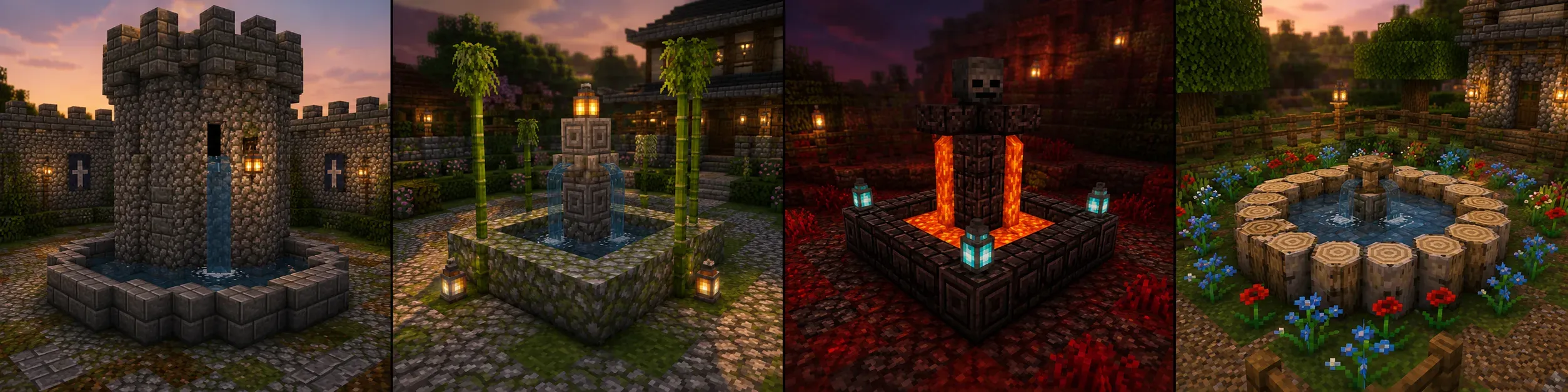
Medieval tower fountain. Diameter 7 round basin set at the base of a round tower, with the spout coming out of an arrow slit halfway up the tower. The water trickles down the tower face into the basin. Best paired with castle walls and curtain walls — the same round-tower template from the Minecraft Castle Round Tower Build Guide gives you matching diameter math for the tower body and basin. Materials: cobblestone tower + andesite basin + iron lantern.
Japanese stone lantern fountain. 5×5 mossy cobble rim around a single chiseled stone pillar, lit lantern on top, water trickling down each face of the pillar. Plant bamboo around two diagonal corners, place a small stone path leading up to it. Reads as zen garden corner piece, not centerpiece. Quiet, low-effort, hard to make look bad. The 5×5 footprint stays square — don’t round this one, the whole aesthetic depends on the orthogonal lines.
Skull lava fountain. Same 5×5 frame as the Japanese variant, but use blackstone for the rim and replace water with lava. Mob skull on top of the central pillar — wither skeleton or zombie, whichever reads more menacing. Reads as villain throne room centerpiece or nether-themed base entry. Survival-feasible but burns flammable blocks within two tiles, so build the surrounding floor in stone or netherrack. Soul lanterns at each corner sell the nether vibe; don’t use regular lanterns here.
Cottagecore wildflower fountain. Diameter 9 round basin in stripped birch logs (not regular oak — the texture matters), water source in the middle on a single dirt block, the outer rim ringed with flowers (azure bluets, poppies, oxeye daisies) and grass blocks. Place a fence around the perimeter at three-block intervals — close enough to feel like a garden boundary, open enough to walk through. This is the best survival-friendly fountain that doesn’t look like a stone slab.
Where to go from here
All three designs above start from a circle of an odd diameter. If you’re still picking a size, the Minecraft Circle Generator on the homepage plots the rim for any diameter from 3 to 128 and gives you the exact block count for cobble, quartz, andesite, or whatever you’re cladding it in. Once the rim is locked, fountain design is mostly material choice — the water and the geometry both run on the same two rules from the top of this article.