A stadium is longer than it is wide. So is a lap pool, a galley hull, a speedway — and every time someone ropes one of those into a perfect circle, it ends up subtly wrong without them being able to say why. The shape they needed was an oval.
TL;DR: Pick a width and a height that differ, mark both axes on the ground, build one quarter against the blueprint, then mirror it — not rotate it — into the other three. The Minecraft Oval Generator draws the ellipse and counts the blocks; this guide covers the part that happens in the world.
Table of contents
Open Table of contents
Why your “circle” is actually an oval
A circle has one measurement: the diameter. Every point sits the same distance from the center, so width and height are the same number — 21 by 21, 40 by 40. An oval throws that out. It has two radii, a long one and a short one, and the curve bends tighter at the narrow ends than along the flat sides. Mathematicians call it an ellipse. In-game it’s a circle someone sat on.
That second axis is what makes ovals hard to eyeball. A circle already drifts a block out of true the moment you trust your eyes — that’s the whole reason builders reach for a blueprint, and why the step-by-step circle method is worth reading first. An oval has two different curves to keep honest at once, so the drift compounds. Get one quarter wrong on a stadium and the far end lands a full block short, plainly visible from the stands.
Most people don’t set out to build an oval. They set out to build a “big round arena,” rough it in by hand, and end up with something that’s neither a clean circle nor a deliberate oval — just lopsided. Deciding up front that the shape is an oval, with a long axis and a short axis you’ve actually chosen, removes most of the guesswork before you place a block.
Pick the ratio before you pick the size
The two numbers matter less than the gap between them. 31×15 and 63×31 sit on nearly the same proportion at very different sizes; 31×15 and 31×25 are different shapes entirely. Settle the proportion first, then stretch it to whatever plot you have.
Roughly 2:1 is the workhorse — stretched far enough to read as an oval, not so far that the ends go flat. That’s the proportion under most tracks and lap pools. Closer to 3:2 gives a soft, wide shape that fills a rectangular plot without announcing itself, and a stadium bowl usually wants to sit around there so the far rows don’t end up miles from the middle. Push past 3:1 and the ends stop feeling curved at all — the shape reads as a rectangle with rounded caps, which is right for a canal and wrong for an arena.
Open the Minecraft Oval Generator and Width and Height are already separate boxes. The page loads on 17×11, so the first thing on screen is an ellipse rather than a circle you have to unlock. Drag either slider and the blueprint redraws with the block count underneath, so you can sit on a few ratios before committing. Four presets cover the sizes ovals usually get built at: 21×13, 31×15, 41×21 and 63×31.
Under the hood it solves the real ellipse equation rather than faking a stretch — each cell is kept or dropped on whether it falls inside (x/rx)² + (z/rz)² ≤ 1. That matters at the narrow ends, where a lazy stretch-a-circle tool throws flat spots or stair-steps that read as broken. The outline stays continuous even on a 41×13 shape that’s almost a lozenge.
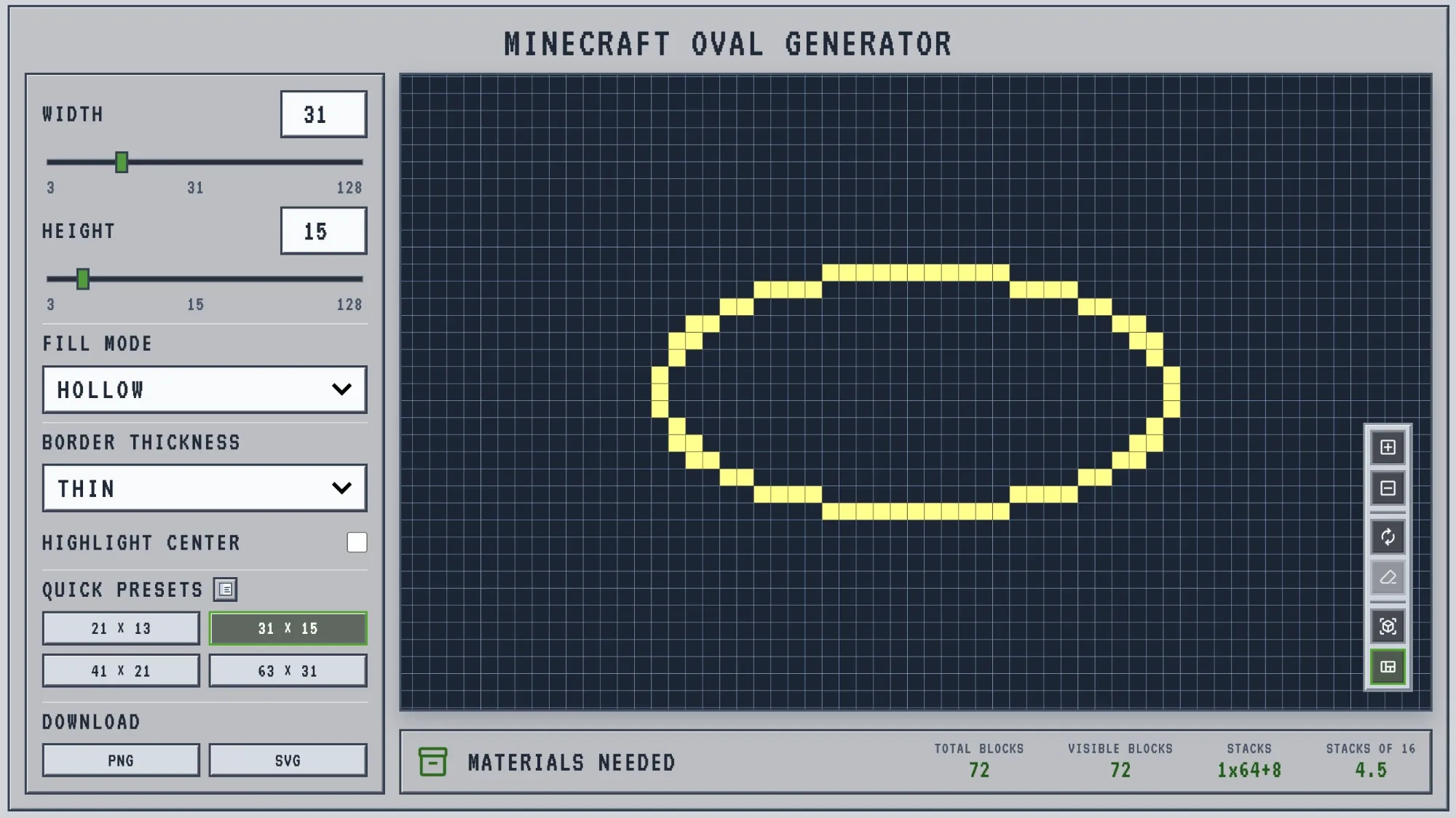
If you happen to be on the circle page already, unchecking Force Circle does the same job — it releases Height from Width and the tool draws ellipses from there. Same maths, one extra click.
Reading the blueprint into the world
This is where the guide and the blueprint part ways. The tool hands you a grid; the four moves below get that grid onto the ground without it drifting.
Mark both axes in a throwaway block. Dirt or wool, one line down each axis, meeting square at the middle. Every measurement from here on is taken off those two lines, so it pays to check the crossing before you go further.
Place the four end blocks. The far point of each axis pins the outline. On a circle those four sit at the same distance from centre; on an oval they don’t, and that asymmetry is the whole point — if all four end up equidistant, you’ve built a circle by accident.
Build one quarter against the blueprint. Work from an end block toward the centre of the adjacent axis, copying the run lengths off the grid. The runs come out long and lazy along the flat side, then tighten fast as you come round the end. That change of pace is what your eye can’t fake.
Mirror it three times — don’t rotate it. This is the single most common way ovals go wrong. On a circle you can build one quarter, spin it 90°, and it fits, because the four quadrants are interchangeable. An oval’s two axes are different lengths, so a rotated quarter lands skewed. Flip it across the long axis for the second quarter, then flip both halves across the short axis for the bottom. If the outline doesn’t close cleanly at the fourth end block, one quarter drifted — and the Materials panel will say so, because your placed count won’t match its total.
One check before you build upward. An oval on odd numbers in both axes — 21×13 — gives a single centre block, clean for a goalpost or a fountain spout. Both even, say 20×12, and the middle is a 2×2. Mix the parities and you get a 1×2 sliver running one way, which makes mirroring awkward on both halves. Switch on Highlight Center and you get lines drawn straight through the middle along each axis — the reference you mirror against.
Hollow or solid, and how thick the rim should be
Everything you know about hollow versus solid from circles carries over. Hollow leaves just the ring — right for a stadium wall or a pool edge you’ll flood. Solid fills the whole footprint, which is what you want under a platform or a foundation slab.
Border Thickness fattens the ring to two or three blocks. That’s how a racetrack or a ring road gets actual width instead of a one-block line; it greys out on solid, since thickness means nothing on a filled disc.
The counts are worth knowing before you mine. A hollow 31×15 oval comes to 72 blocks, where the 31-wide circle that spans it costs 84 — the short axis pulls the outline inward, so stretching a shape costs less material, not more. Paving it is a different order of magnitude — 369 blocks for that same footprint. Total, Visible and Stacks all sit in the Materials panel, and the PNG or SVG export gives you something to keep open on a second screen while you build.
What the blueprint won’t do for you
The oval here is flat — a 2D footprint. The Sphere and Dome pages stay isotropic: every layer is a true circle, so there’s no “3D egg” or ellipsoid mode anywhere on the site. Anyone showing you an ovoid ball stitched it by hand.
That’s less limiting than it sounds, because most oval structures are extruded rather than curved in three dimensions. An oval tower is the same ring stacked floor after floor — exactly how a round tower is a stacked circle. Build the footprint once, copy it upward. The castle round tower guide walks through a 17×11 château flanking tower built this way, including which way the long axis should face along a wall.
So the honest scope: you get a clean 2D oval ring or disc, at any width and height from 3 to 128, hollow or solid, with the block count. Turning that footprint into a dome, a sloped basin or a tapered tower is still a manual job.
Ovals worth building
Stadium or arena — a 61×31 hollow oval gives a playing field with room to step seating up and back from the ring. At this size alignment is the whole battle, because a 61-block axis eyeballed will close a block short. Lock the cardinal points first; the axis method for giant circles works the same on an oval, you just pin two different radii to one crosshair.
Pools and canals go the other way: long and narrow, close to 3:1. 33×11, hollow, one block deep, floored in a lighter block and flooded. The narrow ends are exactly where stretch-tools fail and a true ellipse holds its curve.
Then there’s the case where nobody is meant to notice the shape at all. An oval reads as more organic than a circle, which suits a natural-looking lake or a perimeter wall that isn’t supposed to look surveyed. A wide, shallow oval pond sits well next to the round-basin builds in the fountain design guide when the centrepiece shouldn’t be one more perfect circle.
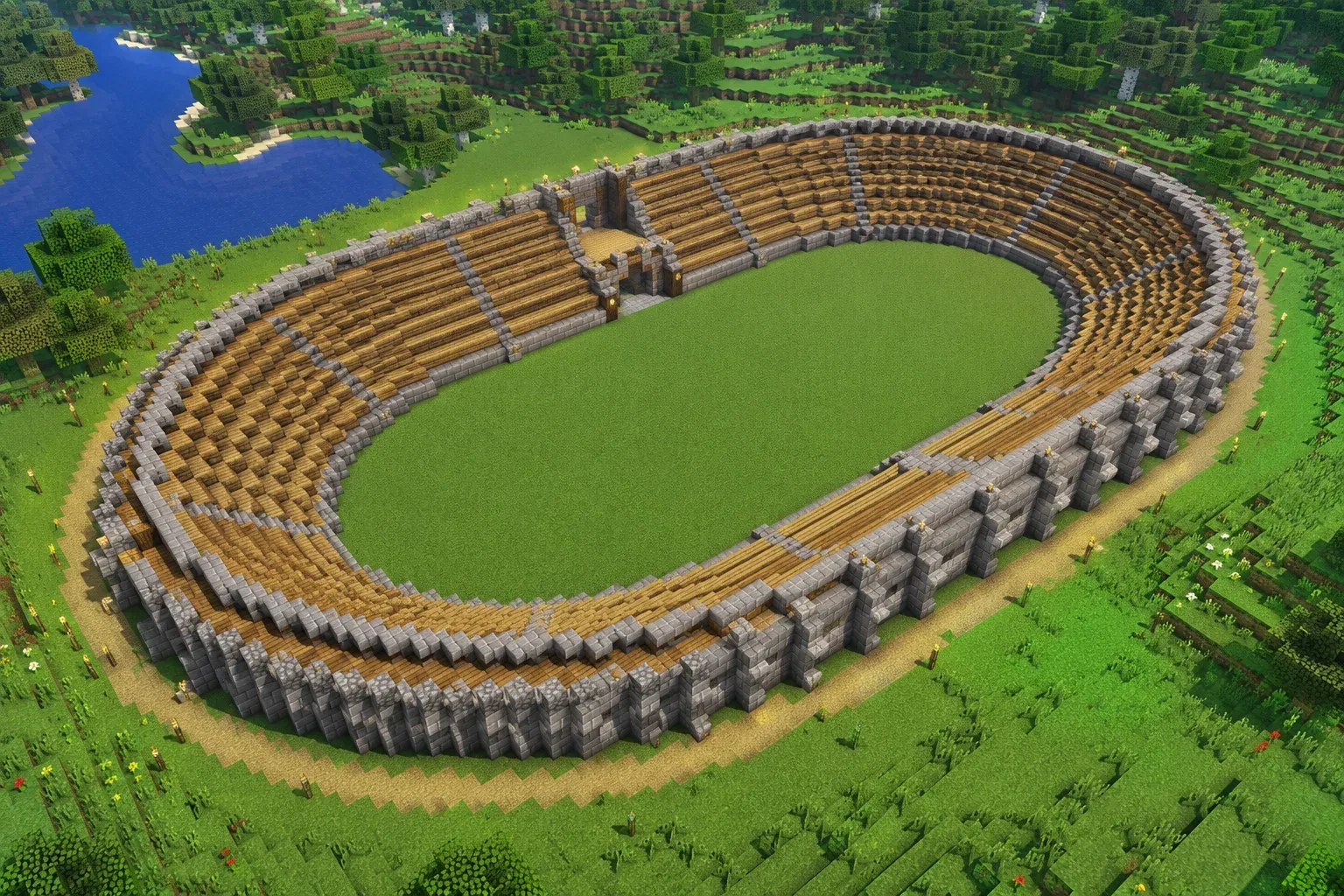
The shape you reach for by reflex is a circle, but plenty of the time the build wants the stretched version — and the gap between a deliberate oval and a lopsided circle comes down to one habit: mirror the quarter, never rotate it. Pick the two numbers, read the runs off the Minecraft Oval Generator, and let the count tell you when a quarter has drifted.