A wizard tower is a round tower that is far taller than it is wide, with a steep pointed roof. The width decides almost everything else, including the cost of the wall: on MC Shapes’ circle, a 9-wide round wall costs more blocks per layer than an 11-wide one.
TL;DR: A Minecraft wizard tower 11 blocks wide, four floors of six layers each, under a steep cone roof, takes 1,221 blocks. The same tower 9 wide takes 1,109 and 7 wide takes 605. Build it 11 wide: each layer of its wall is 28 blocks against 32 for a 9-wide wall, and each floor inside is 69 blocks against 37.
Table of contents
Open Table of contents
Three widths for a wizard tower
A wizard tower reads as one because of its proportions: three or more times taller than it is wide (the 11-wide tower below is 37 tall). Keep the width small and odd, so the tower has a single centre block for a stair column, and the three useful widths are 7, 9 and 11.
Every number below comes from the circle generator set to Hollow, the thin border, one width at a time. MC Shapes is a free, browser-based set of Minecraft shape generators (circle, oval, sphere and dome) that outputs block-by-block blueprints with exact block counts; it does not export schematic files.
| Width | Wall per layer | Floor inside | Four floors, walls 24 tall | Steep cone roof | Total |
|---|---|---|---|---|---|
| 7 | 16 | 21 | 384 + 84 | 137 | 605 |
| 9 | 32 | 37 | 768 + 148 | 193 | 1,109 |
| 11 | 28 | 69 | 672 + 276 | 273 | 1,221 |
An 11-wide wizard tower is 1,221 blocks: 672 in the walls, 276 in four floors and 273 in the roof. A 9-wide tower is 1,109, and 768 of those are wall. A 7-wide tower is 605, but its floors are 21 blocks each, room for a ladder and very little else.
Why 9 wide costs more than 11
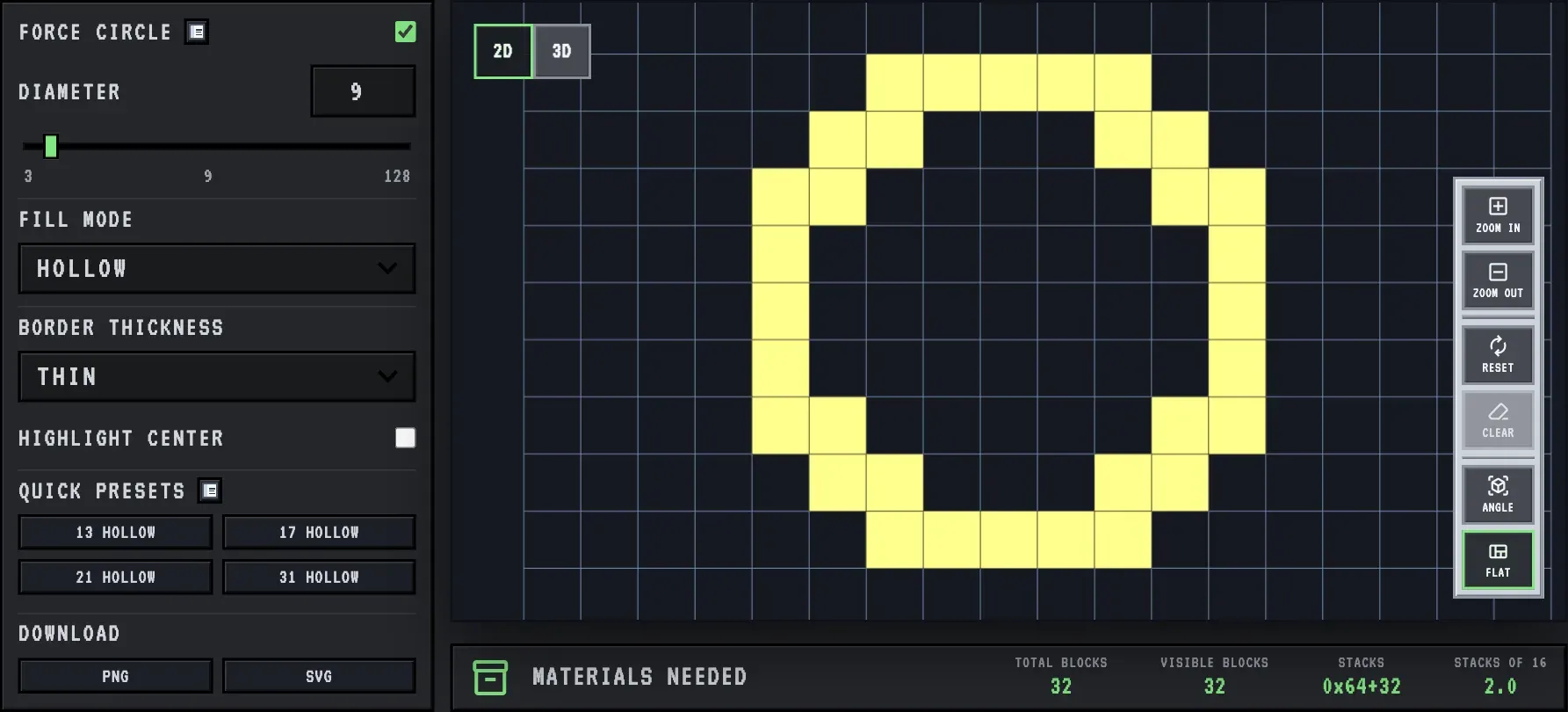
A round wall is drawn as a ring of blocks, and at some widths the ring has to double up on the diagonals to stay closed. The 9-wide ring is one of those: 32 blocks, with an extra block at each of the eight diagonal steps. The 11-wide ring is clean and takes 28.
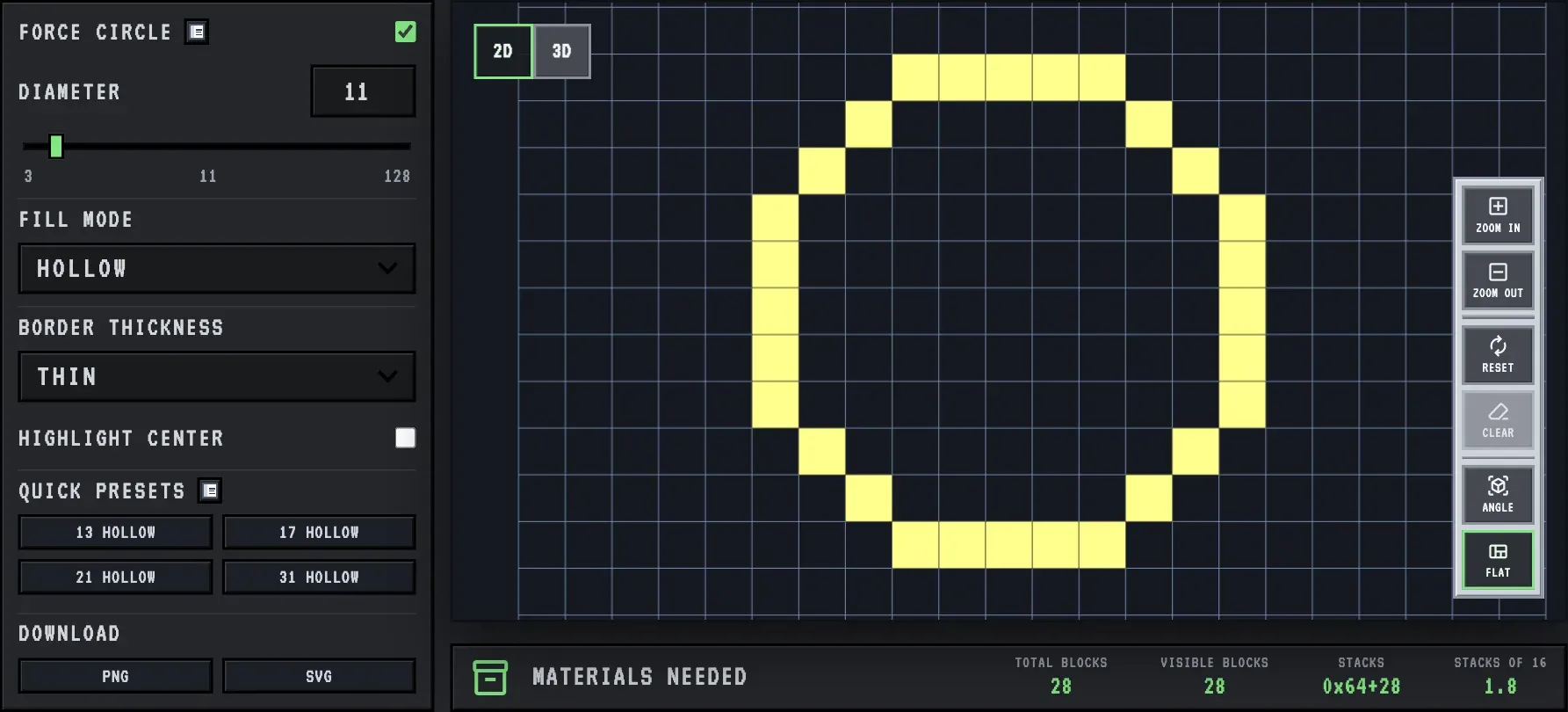
Over a 24-layer shaft that is 96 more blocks for the narrower tower, and you get a smaller room for them: 37 blocks of floor inside a 9-wide wall against 69 inside an 11-wide one. Unless the thinner look matters more than the room, 11 wide is the better tower. The same doubled corners show up at 13, 19 and 23 wide, which is worth knowing before you taper a tower through those sizes. This is how MC Shapes draws a one-block ring; other circle charts round the diagonals differently, and one we found lists a 9-wide ring as 24 blocks (read 14 October 2026), so compare counts from the same tool.
Floors and the shaft
Six layers to a floor gives one layer of floor and five of room, which leaves space for a door, a window band and a ceiling lamp. Four floors make a 24-layer shaft: tall enough to read as a tower, short enough to finish in an evening of creative mode.
Each floor is the solid circle that fits inside the wall: 21 blocks in a 7-wide tower, 37 in a 9-wide one, 69 in an 11-wide one. Leave a hole for the stairs. In a tower with a single centre block, a spiral staircase can turn around that block; how the stair pairs up with the wall is covered in the round tower guide, and the steps themselves are placed by hand.
The steep cone roof
What makes the roof a wizard’s hat is its slope. A normal cone roof steps in by one block all round on every layer. A wizard roof steps in every second layer, so each ring is laid twice and the cone stands twice as tall. It is the method the Minecraft Wiki gives for conical roofs: repeat each diameter for a set number of layers before stepping in (as found by search, 14 October 2026).
Start one block wider than the wall, for the overhang, and work down by two each step:
- On a 9-wide tower: rings of 11, 9, 7, 5 and 3, each laid twice, then one block on top. That is 193 blocks and 11 layers of roof.
- On an 11-wide tower: rings of 13, 11, 9, 7, 5 and 3, each laid twice, then one block. That is 273 blocks and 13 layers.
- On a 7-wide tower: rings of 9, 7, 5 and 3, twice each, then one block. That is 137 blocks and 9 layers.
The 11-wide tower ends up 37 blocks tall: 24 of shaft and 13 of roof. For the shallower cone, the dome cap and the onion dome, the round roof guide has every ring and its count.
A tower that leans or tapers
Wizard towers often narrow as they rise, or kink to one side. Both are a matter of changing the ring partway up. A tower that goes 11 wide for eight layers, 9 for eight and 7 for eight uses 224, 256 and 128 blocks of wall: the middle section costs the most, because 9 is the expensive width.
To lean a tower, keep the ring the same and shift its centre one block every few layers. The generator’s Highlight Center option marks the centre of each ring, which is the block you move.
What the generators don’t draw
MC Shapes has no wizard tower or cone mode. The tower is one ring from the circle generator, repeated layer after layer, and the roof is a series of rings you read off one at a time. Plotz offers a dedicated wizard tower generator with floor and side-tower settings (its own page, read 14 October 2026), if you want the whole model drawn for you.
Everything is full blocks. The stairs and slabs that soften a cone, the windows, the balconies and the spiral steps are hand work.
An 11-wide wizard tower of four floors is 1,221 blocks, and every ring in it is one setting away in the circle generator: set Diameter, keep Fill Mode on Hollow, and the Materials panel gives the count for that layer.