The hard part of a Minecraft circle base is sizing it, because nobody thinks in diameters. A circle 31 blocks wide sounds enormous, and it holds about the same ground as a 27 × 27 square.
TL;DR: A Minecraft circle base 31 blocks wide covers 749 blocks of ground, about the same as a 27 × 27 square. With a wall two blocks thick it takes 172 blocks per layer of wall and leaves 577 blocks of floor, and a dome roof over it is 1,353 blocks.
Table of contents
Open Table of contents
How big is a circle base, really?
A circle fills a little under 80% of the square it is drawn in. So a circular base has to be about an eighth wider than the square room you have in mind: for the floor of a 24 × 24 room, build 27 wide.
The table does that conversion for the sizes people tend to build. Ground covered is the Solid total from the circle generator, the walls are blocks per layer of height, and the dome roof is the hollow total from the dome generator.
| Diameter | Ground covered | Square of equal ground (side) | Wall, 1 thick | Wall, 2 thick | Dome roof |
|---|---|---|---|---|---|
| 13 | 137 | 11.7 | 40 | 68 | 245 |
| 17 | 225 | 15.0 | 48 | 88 | 405 |
| 21 | 349 | 18.7 | 56 | 124 | 653 |
| 25 | 489 | 22.1 | 68 | 140 | 941 |
| 31 | 749 | 27.4 | 84 | 172 | 1,353 |
| 41 | 1,313 | 36.2 | 112 | 228 | 2,573 |
| 51 | 2,053 | 45.3 | 168 | 312 | 4,101 |
| 63 | 3,125 | 55.9 | 192 | 392 | 6,169 |
A 21-wide circle base covers 349 blocks of ground, the same as a square just under 19 × 19. At 41 wide the ground covered is 1,313 blocks, about a 36 × 36 square. The neatest conversion in the table is 17 wide, which comes to exactly 225 blocks, a 15 × 15 square to the block. Other guides I found put a central hub at 17 or 19 wide, and in square terms that is a 15 × 15 to 17 × 17 room, which sounds right for a hub and small for a whole base.
Four of these sizes draw as a clean ring one block thick: 21, 25, 31 and 41. The rings at 13, 17, 51 and 63 double up on the diagonals, and 51 is the worst of them. Its ring is 168 blocks, not far short of the 192 of a 63-wide ring.
Pick the centre before the size
Every diameter in the table is odd on purpose. An odd circle has a single centre block, which is what a beacon, a one-block water elevator or the column of a spiral staircase needs. An even diameter has a 2 × 2 centre, which suits a two-wide stairwell or a 2 × 2 drop shaft and nothing that has to sit on one block.
Highlight Center in the generator shows which of the two you have. On a base this wide the centre also does the layout work: the axis method runs two lines out from it so the far side of the ring does not drift.
A 31-wide base, fully budgeted
Start with the wall. Set Diameter to 31 in the circle generator, Fill Mode to Hollow and Border Thickness to Thick, and the ring is 172 blocks per layer. MC Shapes is a free, browser-based set of Minecraft shape generators (circle, oval, sphere and dome) that outputs block-by-block blueprints with exact block counts; it does not export schematic files. Five layers of wall are 860 blocks.
That wall is cheaper than the square one. A square room with the same floor would be 24 × 24, and its two-block wall takes 208 blocks per layer, 36 more than the round wall on every layer.
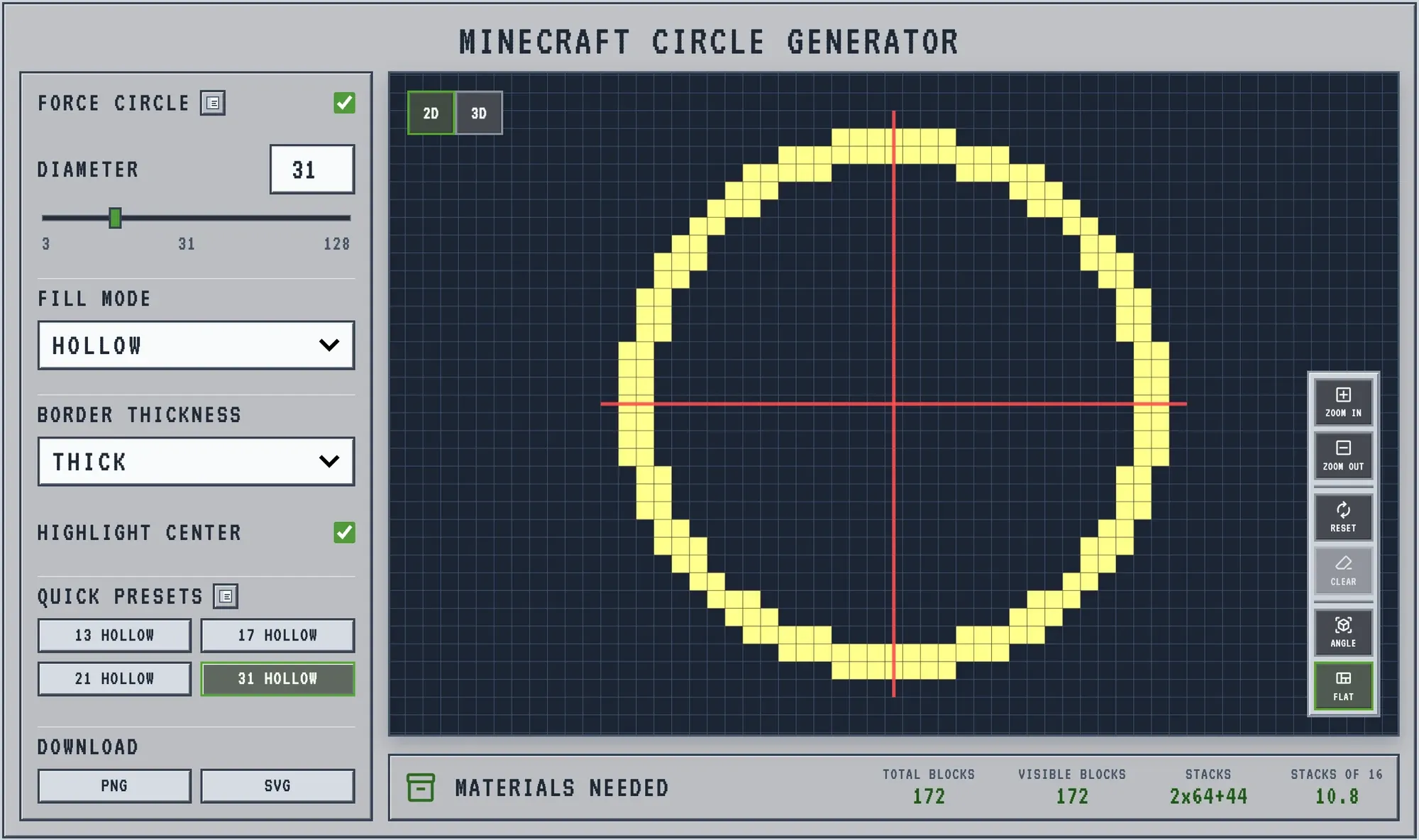
Inside the wall is a disc 27 blocks wide, 577 blocks of floor. Zoning it takes three more circles from the same centre block:
- A hub 9 wide is 69 blocks.
- The ring between the 9-wide and 13-wide circles is a walkway of 68 blocks.
- The band between the 13-wide and 27-wide circles is 440 blocks. Two corridors along the axes take 28 of them and leave four rooms of 103 blocks each, a little more than a 10 × 10 room.
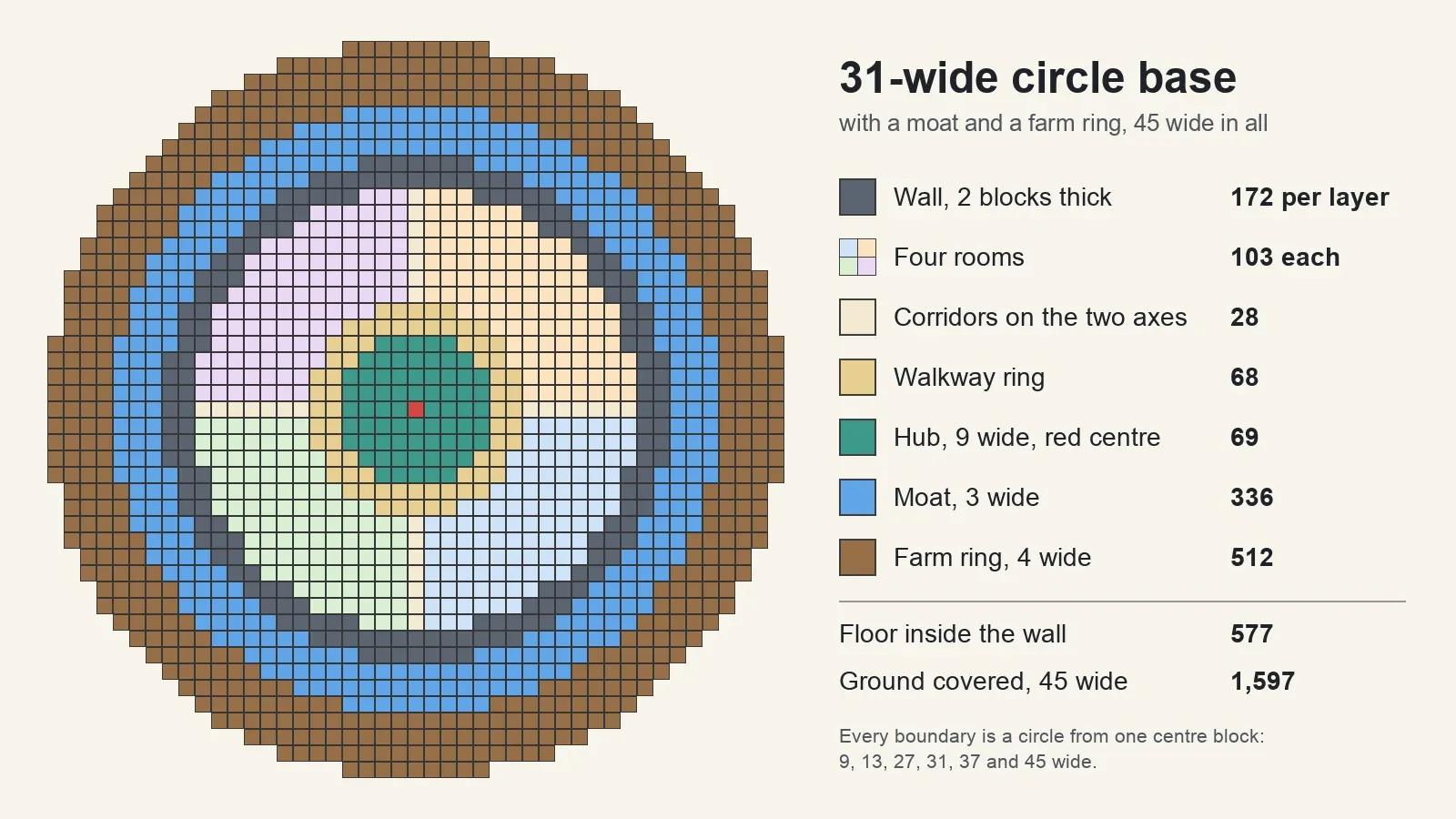
The plan also shows the moat and the farm ring from the section after this one. The zoning is arithmetic. Whether 103 blocks is enough for a storage room is a question for your chest count, and the fix is the same either way: move the 13 circle in or out and run the Solid totals again.
For the roof, a hollow dome on a 31-wide base is 1,353 blocks and rises 16 blocks above the top of the wall; the dome block count tables have the other sizes. A flat roof over everything is 749 blocks. With the dome, the whole budget is 860 for the wall, 577 to pave the floor and 1,353 for the roof: 2,790 blocks, or 43 stacks and 38.
Growing the base outward in rings
The subtraction that zoned the floor works outside the wall too. Each new ring is the Solid total of a bigger circle minus the Solid total of the one inside it, drawn from the same centre block.
A moat three blocks wide around the 31-wide wall is the band between a 31 and a 37 circle, 336 blocks of water surface. A farm ring four blocks wide outside the moat, from 37 out to 45, is 512 blocks of farmland. The Minecraft Wiki gives farmland a hydration range of up to four blocks from water horizontally, diagonals included. I checked every block of that farm ring against the moat and all 512 are in range, so the moat waters the whole circular base farm on its own. At five blocks wide the outer row falls out of range.
With both rings the base is 45 blocks across and covers 1,597 blocks, about a 40 × 40 square.
Underground and island versions
An underground circle base swaps the wall for a dig. The volume to clear is the ground covered times the depth, so a 31-wide base dug 5 blocks deep is 3,745 blocks to remove, which is 58 stacks and 33 of mostly stone. Trace the outline from the Hollow blueprint first and clear inside it; the rock is the wall.
A circle island or a platform over water is the Solid total once per layer of thickness, 749 blocks a layer at 31 wide.
What stays hand work
The circle generator draws one ring or disc at a time, with a border up to three blocks thick. Interior walls, doors, stairs and the split into rooms are placed by hand, and gates through the wall follow the same rules as any round arch. It plots full blocks only.
This article budgets a single round building. For a compound of several, with walls, towers and domes that have to agree with each other, the mega base guide covers how to make the circles fit together.
Work out the floor you want as a square, add an eighth, and round to an odd number. Then set that diameter in the circle generator and read off the wall before you gather for it.