Most of planning a Minecraft race track is arithmetic you can do before placing a block: how long a lap is, how wide the lane is, and how much ice that comes to. An oval answers all three at once, because once you fix its width and height, the lap is fixed too.
TL;DR: A 101 × 51 oval with a 7-wide lane is 1,512 ice blocks and about 224 blocks a lap. That is under 6 seconds for a boat on packed ice at top speed, and about 23 seconds for an average horse.
Table of contents
Open Table of contents
How long a lap do you want?
Start from speed, because it decides the size. The Minecraft Wiki gives a boat 40 blocks per second on ice and packed ice, and about 72.7 on blue ice, in Java Edition. A horse is far slower and varies by animal: 4.86 to 14.57 blocks per second, with an average near 9.71.
Put those against the lap length of a few ovals and the sizes sort themselves out.
| Oval | Lane | Lap, blocks | Boat, packed ice | Boat, blue ice | Average horse |
|---|---|---|---|---|---|
| 41 × 21 | 3 | 91 | 2.3 s | 1.2 s | 9 s |
| 61 × 31 | 7 | 127 | 3.2 s | 1.7 s | 13 s |
| 81 × 41 | 7 | 176 | 4.4 s | 2.4 s | 18 s |
| 101 × 51 | 7 | 224 | 5.6 s | 3.1 s | 23 s |
| 127 × 63 | 7 | 286 | 7.1 s | 3.9 s | 29 s |
A 41 × 21 oval is a lap of about 91 blocks. A boat on packed ice covers that in 2.3 seconds at top speed, which is not a race; an average horse takes about 9 seconds, which is. The largest 2:1 oval the generator draws with odd sides is 127 × 63, and even that is a lap of about 286 blocks: 7.1 seconds on packed ice, 3.9 on blue ice. An oval that fits one blueprint is a sprint circuit as a boat race track and a proper course as a horse race track.
Two caveats on those numbers. The lap is measured along the middle of the lane from the perimeter of the ellipse, so it is a close estimate and not a block count. And the times are a floor: they assume top speed the whole way round, which nobody holds through the ends.
How wide should the lane be?
Two boats side by side need 2.75 blocks, because the wiki lists a boat at 1.375 blocks across in Java Edition. A 3-wide lane fits them with a quarter of a block to spare on the long sides and almost nothing through the turns, which makes it single file in practice.
The advice I found from people who run boat races goes much wider: about six blocks as an average, and 10 to 15 where they had the room, because a boat on ice barely steers. I have not raced these widths myself, so I am passing that on as I found it. It is the reason the table in the next section runs up to 11 wide, and why the worked numbers in this article use 7.
Horses are the easy case. A horse is about as wide as a boat but turns on the spot, and 5 wide is plenty for two riders.
Lane width is a second oval
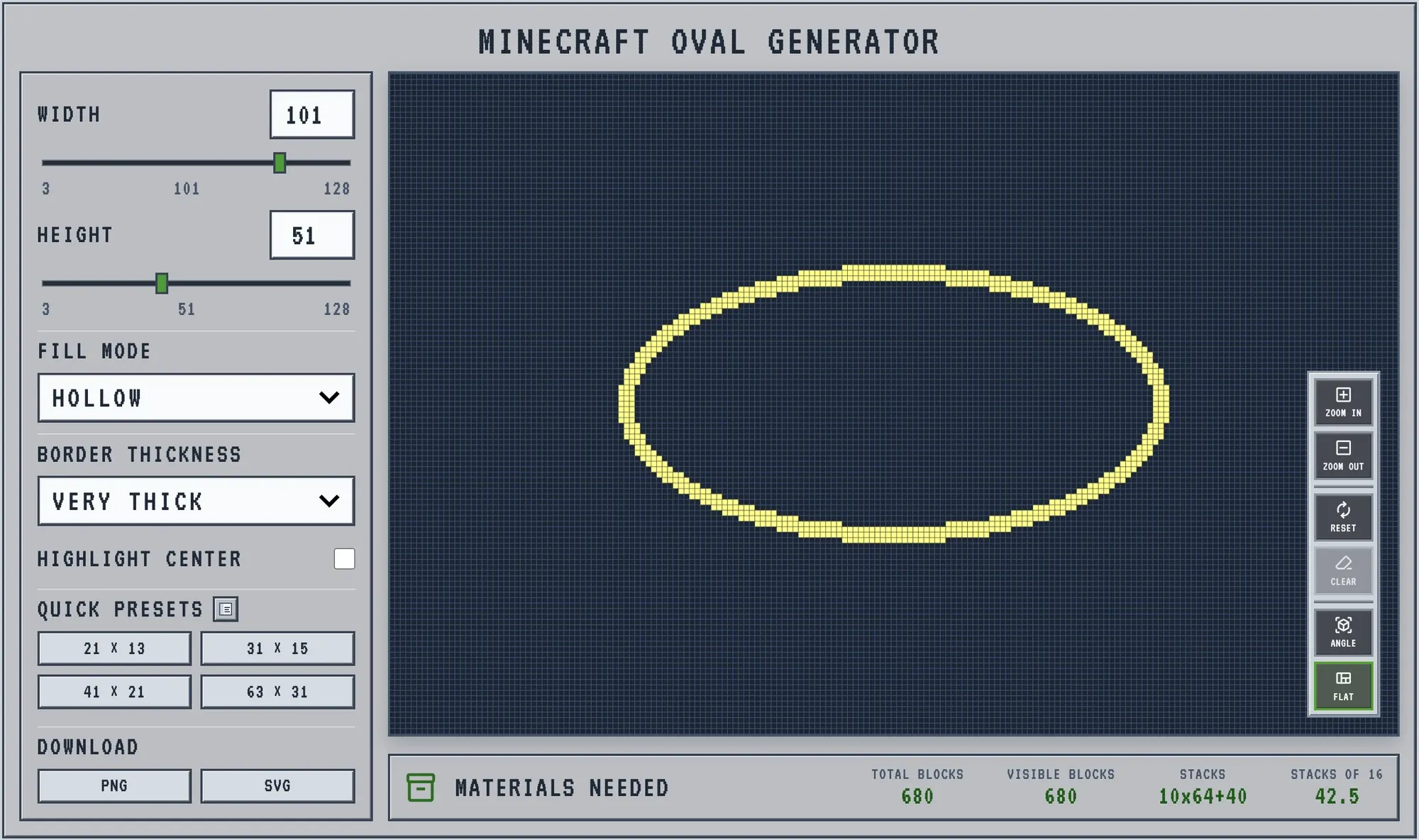
A 3-wide lane comes straight out of the oval generator: set Width and Height, choose Hollow, and set Border Thickness to Very Thick. MC Shapes is a free, browser-based set of Minecraft shape generators (circle, oval, sphere and dome) that outputs block-by-block blueprints with exact block counts; it does not export schematic files. Border Thickness stops at three blocks, so a wider lane needs one more step.
That step is subtraction. I checked the generator’s Very Thick ring against a simpler sum, the Solid total of the oval minus the Solid total of an oval six blocks smaller each way, and the two matched exactly on all five sizes below. For a 7-wide lane, run the oval twice in Solid mode, once at full size and once 14 blocks smaller each way, and subtract. For 5 wide go 10 smaller, and for 11 wide go 22.
| Oval | 3-wide lane | 5-wide lane | 7-wide lane | 11-wide lane |
|---|---|---|---|---|
| 41 × 21 | 264 | 412 | 532 | n/a |
| 61 × 31 | 400 | 644 | 864 | 1,212 |
| 81 × 41 | 548 | 884 | 1,192 | 1,740 |
| 101 × 51 | 680 | 1,112 | 1,512 | 2,248 |
| 127 × 63 | 864 | 1,412 | 1,932 | 2,900 |
A 101 × 51 race track is 680 blocks with a 3-wide lane, 1,112 blocks at 5 wide, 1,512 blocks at 7 wide and 2,248 blocks at 11 wide. The infield left inside the 7-wide version is an 87 × 37 oval, which is room for a pit area or a pond. A 41 × 21 oval has no room for an 11-wide lane at all.
One thing the subtraction hides: two ovals 14 blocks apart in size are not a constant distance apart. Measured square across the lane, a 7-wide lane on a 101 × 51 oval is exactly 7 blocks where it crosses the axes and tightens to about 6.5 through the turns.
The ice bill
Ice is what makes a boat track expensive, and the multipliers are steep. Per the wiki, one packed ice is crafted from 9 ice, and one blue ice from 9 packed ice, which makes a blue ice block 81 ice.
For the 101 × 51 track with a 7-wide lane, 1,512 blocks of packed ice are 13,608 ice. The same lane in blue ice is 122,472 ice. Blue ice is the faster surface, about 1.8 times the speed of packed ice by the wiki’s numbers, but I cannot tell you how much of that survives the turns. For a first track I would build in packed ice and keep blue ice for the long sides if the laps feel slow.
Plain ice is the cheapest option and the one that bites later. The wiki says ice melts when the block light next to it is above 11, and that packed ice does not melt near light sources. Sky light does not count, so a plain-ice track is safe in daylight and unsafe next to the torches you add for night races.
A horse track skips this section. The lane counts are the same, in whatever block you like.
Laying out the race track without drifting
An oval this size will close a block short if you trace it by eye. Mark both axes first in a throwaway block, place the four end blocks, build one quarter against the blueprint, and mirror it into the other three. The order matters more on an oval than on a circle, because a quarter rotated instead of mirrored lands skewed; the step-by-step oval guide covers why. On the 101-block axis, the axis method for long builds keeps the far end honest.
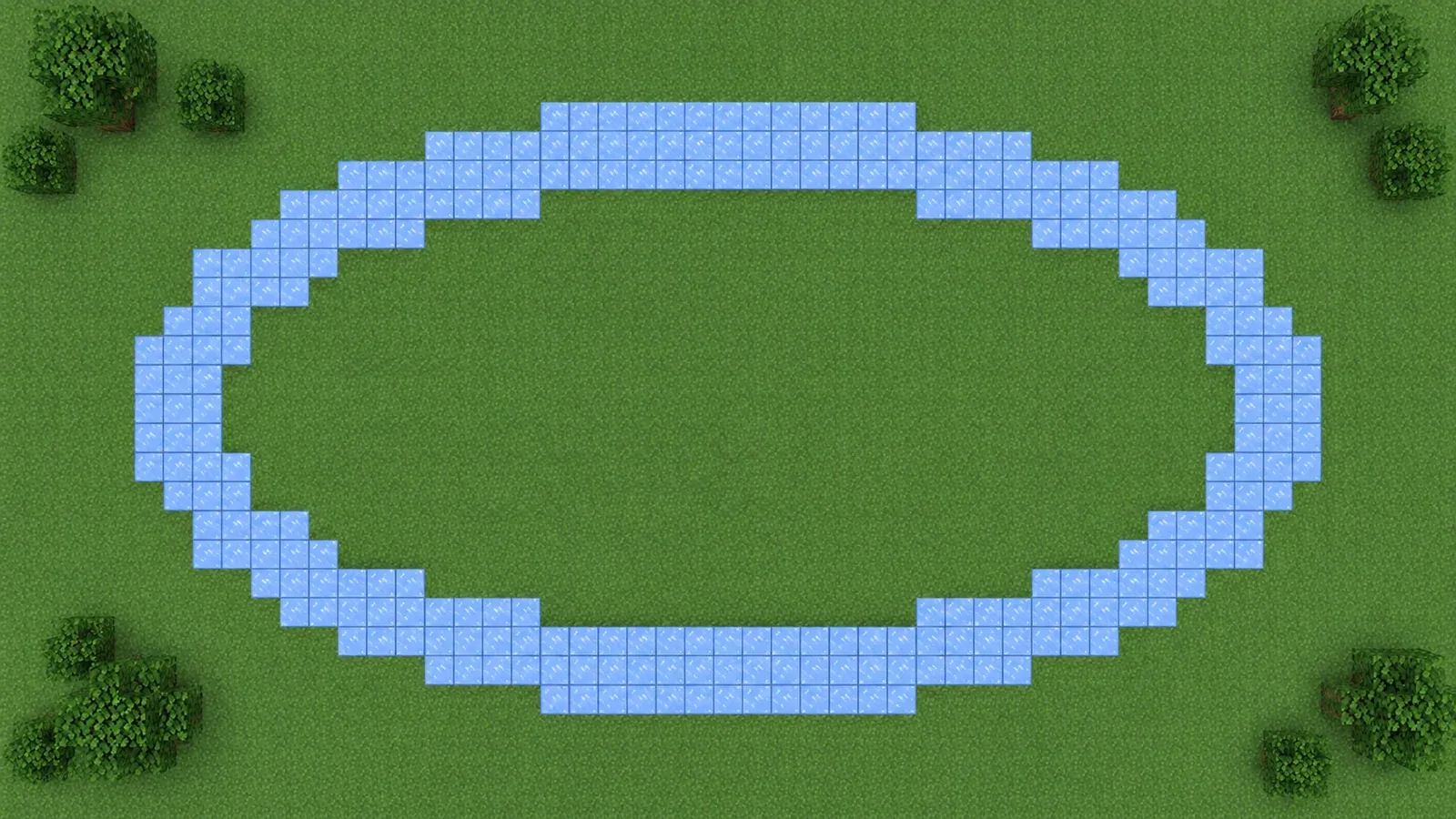
Kerbs are two more ovals. For the 101 × 51 track with a 7-wide lane, the outer kerb is the thin hollow ring of a 103 × 53 oval, 236 blocks per layer, and the inner kerb is the thin ring of the 87 × 37 infield, 200 blocks. I checked both against the lane, and neither ring shares a block with it.
Put the start line on one of the long sides. The runs there are the longest and straightest on the blueprint, which gives boats a few blocks to get moving before the first end.
Grandstands, and what stays hand work
Seating is the same trick as the lane, pointed outward: bigger ovals sharing the centre, each one a step higher. The colosseum build works through stepping rings up and back from an oval, and all of it carries over.
The oval generator draws flat ovals and nothing else. Banked ends, chicanes, a figure of eight and pit lanes are placed by hand, and each axis stops at 128 blocks, which is why the table ends at 127 × 63. It also plots full blocks only, so slab kerbs and stair banking are yours to work out.
Pick the lap first. With the width and height set in the oval generator, the lane comes off the Very Thick ring or the two Solid totals, and the ice bill for the whole race track is known before you craft any of it.