A glass dome looks like the hard part is the curve. It isn’t. Once a dome generator hands you the rings layer by layer, the shape almost builds itself — the real work is everything glass drags in with it: a shell thin enough to see through, lit so it doesn’t turn into a creeper trap after dark, and something worth looking at underneath.
TL;DR: A Minecraft glass dome is a hollow half-sphere shell. Size it 13–31 blocks across, raise it on a frame, read the Total Blocks count for your glass order, and light the floor so mobs don’t spawn under it at night.
Table of contents
Open Table of contents
A glass dome is a shell, not a solid
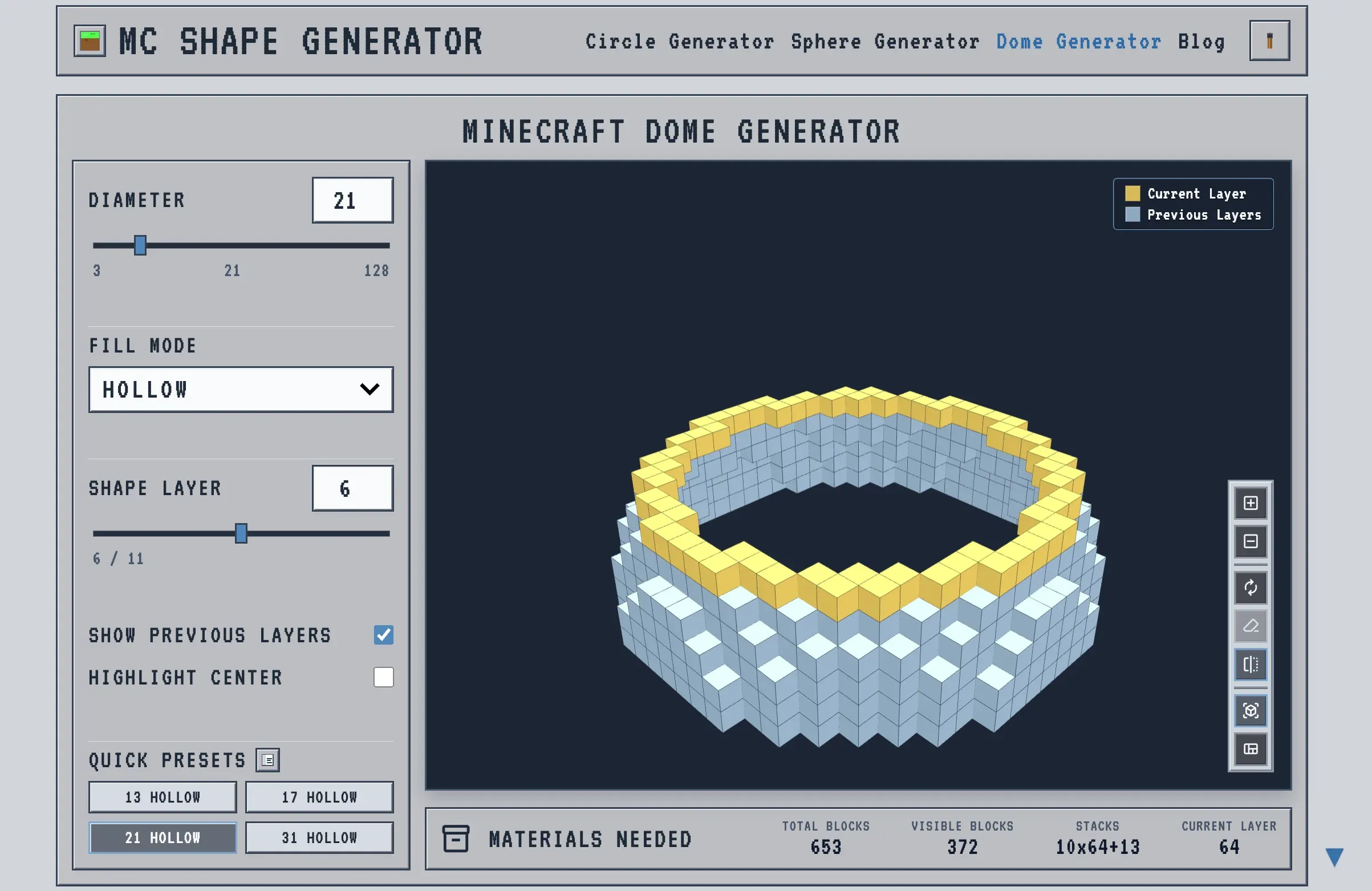
The single decision that separates a glass dome from every other dome is fill mode, and it only ever goes one way: hollow. A solid dome is a pile of stone you’d have to carve back out; a glass dome is the carving — an empty half-sphere you live inside. So the moment you open the Dome Generator and pick a diameter, leave Fill Mode on Hollow and never touch it.
That hollow shell is also why glass is forgiving in a way solid builds aren’t. You’re placing one layer of blocks, not a volume, so the cost stays sane even at sizes that would bankrupt a solid build. The generator caps the build at the sphere’s hemisphere — a dome is the bottom half of a voxel ball, nothing new to learn — and the layer slider walks you up ring by ring from the wide base to the small cap. Each ring is just a circle. Stack the circles and the curve appears on its own.
How big before the glass reads as a curve
Under about 11 blocks across, a dome reads as blocky steps instead of a curve — the rings are too short to round off, and glass makes that worse because you can see straight through to the jagged silhouette. Thirteen to twenty-one is the practical band for most builds: a 13 dome caps a small greenhouse or a well, a 21 covers a starter base without swallowing your whole render distance.
Push to 31 and up when you want the build to read as grand from across the map — an observatory, a stadium roof, a biodome you can put a tree inside. The curve smooths out at that scale and the extra glass actually earns its place. There’s no single right number; the honest test is to plot two diameters in the tool, eyeball the rings, and pick the one whose curve you can live with before you mine a single pane.
Think about it as floor space, because a dome’s interior is a circle and a circle is smaller than it looks. A 13 dome leaves you a roughly 11-wide floor once the wall eats the edge — enough for a well cover, a single sapling, or a tight garden plot. A 21 opens up to a four-or-five-bed garden with a path down the middle. Step up to 31 and a full-grown tree fits inside with room to walk around it — that’s the threshold where “biodome” stops being a stretch. Whatever you land on, switch on Highlight Center: the crosshair marks the dome’s exact middle so you can seat it square on the base, well, or platform it’s capping instead of nudging it a block off and living with the gap forever.
Build the frame before the glass
A wall of plain glass blocks reads as a soap bubble, not a structure — there’s nothing for the eye to hold onto. The fix every good glass dome uses is a frame: a skeleton of opaque blocks along the dome’s main lines, with glass filling the panels between. Iron blocks and dark stone read modern and clean; quartz or smooth stone reads like a botanical conservatory; deepslate and copper lean greenhouse-industrial. The glass just fills the gaps the frame leaves open.
Frame placement has a rhythm worth getting right. The natural ribs run from the base up to the cap along the dome’s vertical lines, and the cleanest way to space them evenly is off the cardinal axes — turn on Highlight Center, drop a frame rib on each of the four crosshair points, then split the arcs between them into equal bays. Four ribs reads minimal and modern; eight gives a denser conservatory look. The horizontal frame is easier: every third or fourth ring up gets a solid band instead of glass, which doubles as a ledge for hanging lanterns later.
Here’s the one thing the tool won’t do, and you should know it going in: the generator renders the shell in plain voxels — it doesn’t show glass, and there’s no block-color or material picker. It’s a counting and shape machine, not a material previewer. What you get from it is the exact shape and the block totals; the framing-versus-glass split is a decision you make in-game, deciding which rings carry the frame and which stay open. If you want the underlying shape mechanics first — how the base ring sets everything above it — the step-by-step dome walkthrough covers laying the rings before you start swapping in glass.
How much glass the shell actually costs
This is where the hollow shell pays off. The number you want is Total Blocks — for a hollow dome that’s every block in the shell, which is exactly what you place: glass and frame together. The panel also shows Visible Blocks below it, but that only counts the outward-facing surface, so don’t shop off that one or you’ll come up short by the inner and underside blocks. Read Total Blocks, subtract whatever rings you’re handing to the frame, and the rest is your glass order before you ever touch the furnace. A hollow 21 dome, for reference, runs about 650 blocks for the whole shell.
That number climbs fast with diameter, which is the figure people guess wrong most. Jumping from a 21 dome to a 31 isn’t fifty percent more glass — a glass dome’s shell scales with the square of the radius, so it’s closer to double. Sand for that much glass is a real survival commitment, so read the count first and decide whether you’re smelting it or switching to the Creative palette.
The first proper glass dome I built was a 31 over a jungle tree, and I didn’t check the count — the sand run alone took longer than framing and lighting the whole thing put together, and I ran a furnace array dry twice. Now I read Total Blocks before I commit to a diameter, every time. If you want the full math on how shell counts grow with size, the sphere block-count guide walks the same curve a dome rides up to its hemisphere.
Light it or it’s a creeper trap after dark
Glass lets daylight pour in, which fools people into thinking a glass dome is self-lighting. It isn’t. The sun goes down, the floor inside goes dark, and any opaque block down there starts spawning mobs — you wake up to a creeper standing on the petunias. The glass roof keeps rain and skeletons out; it does nothing about the dark floor underneath.
The detail worth knowing: mobs can’t spawn on the glass itself — they need a solid opaque surface — so the dome shell isn’t the problem. The threat is whatever you’ve floored the interior with. Grass, dirt, stone, a farm plot: all of them spawn mobs in the dark, and a big domed floor is a lot of dark to cover. That’s the surface you have to light, not the glass.
So light the interior as if there were no glass at all. Sea lanterns sunk into the floor or hidden under planters keep the light level up without cluttering the view through the dome — glowstone works too if you don’t mind the warmer tone. The clean trick is to run the lighting into whatever you’re building underneath rather than dotting torches around: lanterns under garden beds, a glowstone core in an observatory pillar. Done right, the dome glows from within at night and nothing ever spawns to break the glass.
What goes under the glass
A dome is just an enclosure until you give it a reason to exist, and glass picks the reasons for you. A greenhouse is the obvious one: crops and flowers need light, glass delivers it, and the shell keeps mobs off the rows — sink some bee nests in for a pollinator dome, or terrace the floor for a tiered garden. Swap the planting for a single big tree and you’ve got a biodome; line the dome with stained glass and a telescope-shaped centerpiece and it’s an observatory.
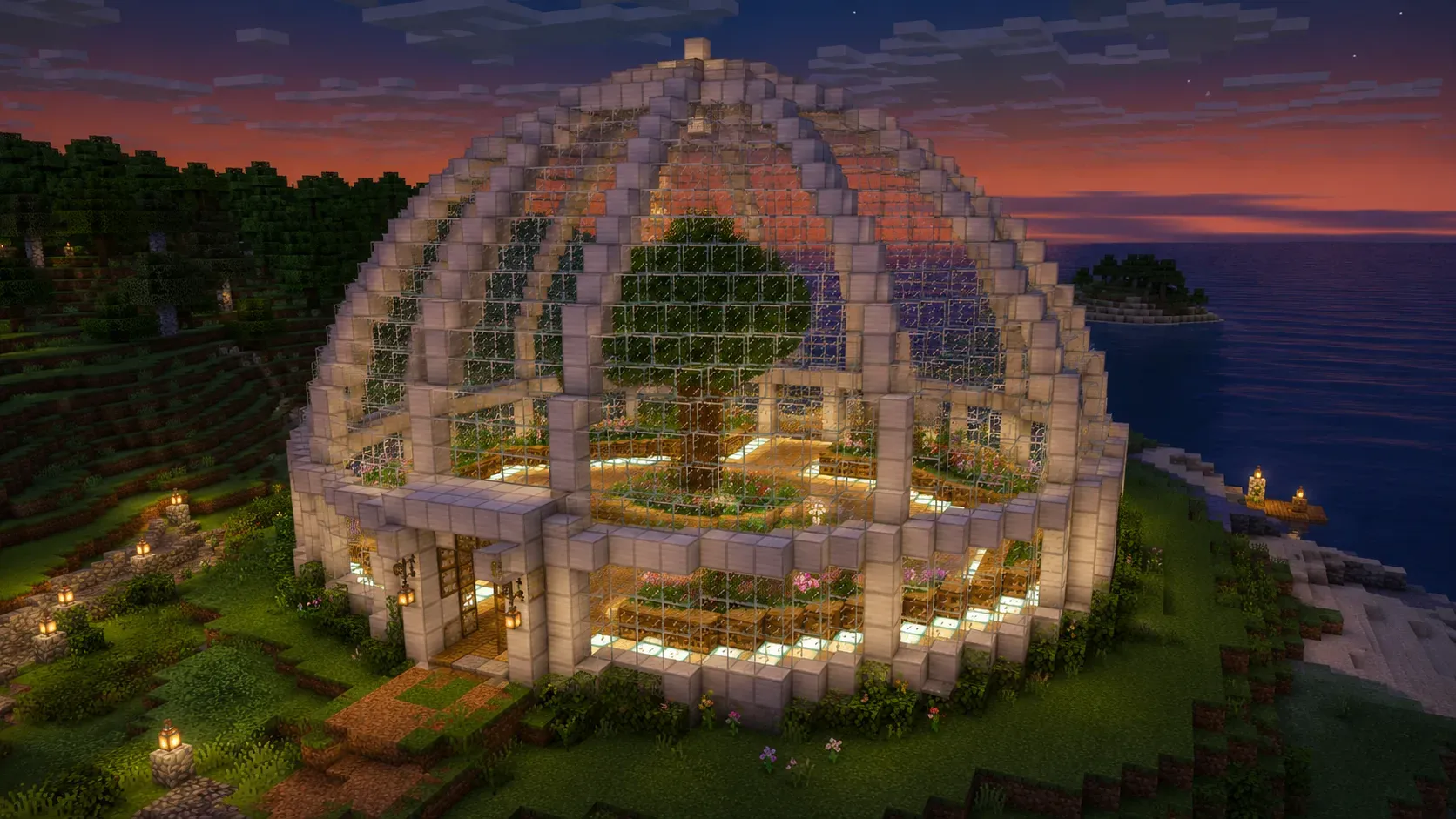
Underwater is the showpiece — a glass dome on the seabed with the build dry inside and ocean pressing on every pane. It’s the same hollow shell; you just place it below sea level and clear the water out by hand or with sponges. And at the largest sizes, a glass dome becomes the centerpiece of a base rather than a side build — a domed atrium the rest of a circular mega base grows around. The shape stays identical from a 13-block well-cover to a 63-block atrium; only the count changes.
One last honest note on scale: the generator’s axis caps at 128 blocks, which is far past anything a glass dome wants — a 128 dome is a stadium most servers would never finish. The limits that bite a glass dome are survival glass cost and night lighting, not the tool’s range. Settle the diameter and the Total Blocks count in the Dome Generator first, frame it, light it, and the dome you pictured is just a matter of stacking the rings it already drew for you.